
One trustworthy brand.
Traditional SEO helps people find your website. GEO focuses on making reliable business information easier to understand and potentially reference in AI-assisted search. The strongest strategy combines accessible pages, useful answers, consistent business details and real evidence. Neither guarantees rankings or AI citations.
A practical SEO and AI search guide for Kenyan businesses
What SEO and GEO actually mean in practical terms
Search engine optimization (SEO) improves how a website can be discovered, crawled, understood and selected in traditional search results. It includes technical access, useful content, internal architecture, relevant links, local signals and measurement. A well-optimized page still needs to deserve a result; metadata alone is not a ranking strategy.
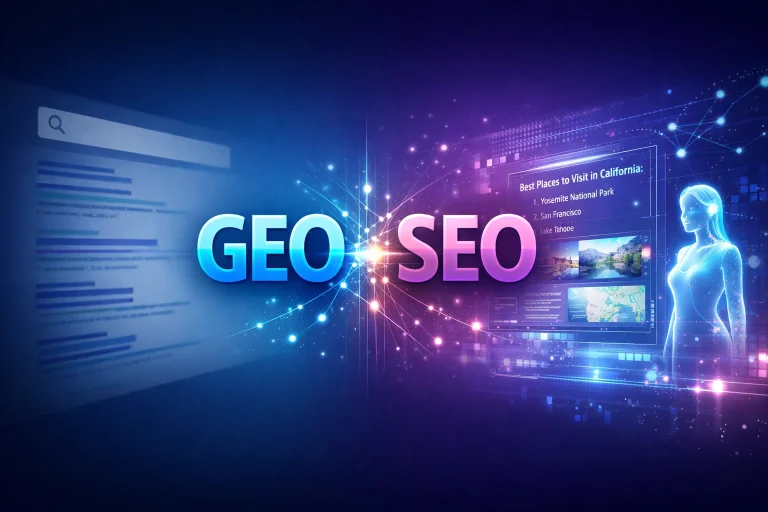
Generative engine optimization (GEO) is a working industry term for making a brand and its information easier for AI-powered discovery systems to interpret, verify and cite when relevant. It is not a separate switch in Google Search Console, and there is no guaranteed placement inside ChatGPT, Gemini, Perplexity or Google AI features. Much of the durable work overlaps with SEO: accessible pages, clear entities, evidence and genuinely useful answers.
For a Kenyan service company, a practical example is a searcher asking “Which company can build a WooCommerce store that accepts M-Pesa?” A traditional result may show a service page; an AI response may summarize several providers. Both need credible, specific information, but the answer format and attribution can differ. The strongest approach improves the underlying business information rather than chasing a secret prompt formula.
| Question | Traditional SEO emphasis | GEO / AI discovery emphasis |
|---|---|---|
| Where does visibility appear? | Organic results, maps, snippets and other search surfaces | AI-generated answers and recommendations where supported |
| What content helps? | Pages matching intent, technical clarity, trust signals | Clear facts, answerable passages, credible sources and entities |
| How do you measure? | Search Console clicks, impressions, queries, conversions | Referrals, citation observations, branded demand and conversions |
| Can results be guaranteed? | No | No |
The overlap is larger than the difference
An AI system cannot reliably use a page that is inaccessible, ambiguous or misleading. If your important pages return errors, hide key information behind interactions, or contradict one another, improving the prose alone will not solve the discovery problem. Start with crawlable HTML, sensible navigation, stable canonical URLs and consistent business details.
Clear service descriptions also help both channels. Instead of a vague claim such as “we provide transformative solutions,” explain the actual deliverables: website design, e-commerce development, payment integration, maintenance or local SEO. Include who the service suits, how the process works, realistic limitations and a way to contact the provider.
Google says its AI features use the same foundational SEO best practices as Search; there are no special technical requirements or special schema types needed solely to appear in AI Overviews. This matters because agencies sometimes sell artificial “AI indexing” toggles that do not exist. For a solid foundation, review Afix Smart Web’s SEO and AI visibility services and the actual quality of each service page.
How the same user journey can look different
Imagine a Nairobi retailer comparing a website builder with a professionally developed WooCommerce store. In traditional search, the retailer might read a pricing page, compare several results and then request a quote. In an AI assistant, the retailer may ask a longer question about stock management, M-Pesa, delivery areas and recurring costs. The assistant may provide a synthesis rather than a list of blue links.
To serve both journeys, write a strong commercial page that explains scope and pricing assumptions, then support it with educational articles that answer the detailed objections. A pricing page should not become a giant FAQ stuffed with unrelated questions; the supporting article should link naturally to the relevant e-commerce website development service.
Your goal is to be understandable at every stage: discovery, evaluation and decision. A reader who arrives from a Google result and a reader who arrives after an AI recommendation should both find the same truthful service facts, the same company identity and a clear next step.
Question → evidence → decision
A strong answer identifies the user’s problem, explains the available options, gives concrete trade-offs, then directs readers to a relevant service or deeper guide. This is a content strategy, not a trick to force AI citations.
A seven-part SEO and GEO implementation framework
1. Technical access. Make sure important pages load reliably, are indexable when intended, and are linked through normal navigation. Confirm canonicals and sitemaps. A sitemap is a discovery aid, not an instruction to index everything.
2. Search intent. Separate informational, commercial and local searches. “What is GEO?” needs an educational explanation; “GEO services Nairobi” needs a relevant service page. Mixing both without structure weakens the experience.
3. Entity clarity. Use one consistent business name, website, contact details and service taxonomy. A company should not describe itself differently on its homepage, location pages and profiles.
4. Evidence. Explain methods, constraints and examples. Use real case studies only when permission and data exist. Do not invent client growth percentages or AI citations.
5. Answer formatting. Put a direct answer near the top, then develop it through useful headings, comparison tables and examples. Avoid rewriting every heading as a near-duplicate keyword.
6. Supporting content. Build clusters that genuinely answer different questions. Link relevant articles to a strong core service page without placing the same sales link in every paragraph.
7. Measurement. Track impressions, clicks, assisted enquiries and the actual search terms generating business. Observe AI referrals carefully; many AI interactions will not generate measurable website visits.
- Audit your main commercial pages before publishing dozens of related blogs.
- Use Search Console to locate real queries, weak pages and indexing problems.
- Update examples and pricing assumptions when conditions change.
- Review your Nairobi services page for consistent location-specific business information.
What to measure without pretending AI traffic is fully visible
Google Search Console provides search performance data but does not offer a universal separate report of every AI Overview citation or recommendation. In analytics, traffic from some AI assistants may appear under identifiable referrers, while other visits may be direct, unattributed or absent entirely. A missing referral does not prove a brand was never mentioned.
Monitor traditional search performance alongside qualified enquiries, branded searches, direct visits and any attributable AI referrals. If you test prompts manually, use a repeatable sample, record the date and region, and avoid presenting one assistant response as a stable ranking.
A sensible monthly report might include ten high-intent queries, the landing pages that answer them, conversion actions and a short log of visible AI mentions. This gives the business something actionable without inventing a “GEO score” that claims to represent all AI systems.
| Metric | Useful interpretation | Common mistake |
|---|---|---|
| Search Console clicks | Actual visits from Google Search | Treating impressions as customers |
| Qualified leads | Enquiries with a relevant business need | Counting every form submission equally |
| AI referral sessions | Some attributable assistant-driven visits | Assuming all AI exposure is measurable |
| Branded searches | Possible growth in recognition | Attributing every change to GEO |
Common GEO mistakes that also hurt ordinary SEO
Publishing hundreds of nearly identical location pages is not a substitute for local evidence. If the same text is repeated with only the town changed, visitors learn little about the actual service in their area. Similarly, adding unsupported claims about being “the most recommended company by ChatGPT” can damage credibility.
Another mistake is implementing structured data that does not match visible content. Markup should describe the page accurately; it cannot create missing expertise or guarantee enhanced search appearances. If you use a WordPress SEO plugin, avoid multiple plugins generating conflicting schema or canonical tags.
Finally, resist changing content every time an AI tool produces a different answer. Prioritize stable improvements: better service descriptions, documented processes, clear pricing boundaries and helpful educational resources. These benefit real readers even when AI products change.
A practical 30-day plan for a Kenyan business
In the first week, audit technical access and the five pages most likely to convert. Check titles, indexability, canonicals, mobile usability and obvious contradictions. In the second week, rewrite vague service descriptions into precise answers with scope, limitations and evidence.
In the third week, publish two or three genuinely different supporting articles, each answering a specific question and linking to the most relevant commercial page. In the fourth week, review search performance, referral sources and enquiry quality. Make the next changes based on observed gaps, not a fixed quota of keywords.
If your website needs a structural refresh, the website revamp service can be a more effective starting point than adding another blog. Good discovery begins with a site that readers can actually use.
When to prioritize SEO, GEO or both
If your website has serious indexing problems, broken navigation or no clear service pages, prioritize foundational SEO and usability first. If your technical setup is healthy but your content is generic, strengthen direct answers, evidence, entity clarity and the depth of your service information.
Most established Kenyan businesses should not buy “SEO versus GEO” as competing products. They need one coordinated visibility plan with measurable goals, editorial standards and honest reporting. The implementation can be staged according to budget, but the underlying business facts should remain consistent.
How to plan content that answers different search intents
Begin by listing the decisions your prospective customers make before contacting you. A Kenyan business owner choosing a website provider may ask whether to use WordPress, what a custom application costs, how payment integration works and what ongoing support includes. These are related questions, but they are not interchangeable. Each deserves an answer at the right depth and on the right page.
Map the decision journey from problem recognition to comparison and then purchase. A concise service page can answer who the service is for, what is included, how work is delivered and how to request a quote. A supporting blog can compare technologies, explain implementation risks and show the reasoning behind a choice. This separation gives readers a coherent path without making every article an advertisement.
Do not create multiple near-identical pages merely because a keyword tool suggests slight variations. A single authoritative comparison is usually more useful than separate posts for “SEO or GEO,” “GEO vs SEO” and “difference between SEO and GEO” that repeat the same facts. Consolidate overlapping intent and strengthen the one page that best answers it.
For a business evaluating technology investments, a transparent website design pricing guide can complement a strategy article by showing how scope and features influence costs. The internal link belongs where the reader needs a concrete next step, not as a repeated keyword anchor.
How to evaluate claims made by an SEO or GEO provider
Ask a prospective provider what will actually change on the website. A credible plan should name specific pages, technical issues, content gaps, tracking requirements and review dates. If the proposal only promises “first-page AI rankings” without explaining how results will be measured, it is not a reliable operational plan.
Request a baseline before work starts. This might include Google Search Console performance for relevant pages, existing enquiry sources, indexed URL quality and a review of the business information displayed publicly. Establish which outcomes matter: qualified calls, relevant form enquiries, bookings or sales. Avoid confusing a rise in impressions with a rise in customers.
Look for honest limitations. A provider cannot control which sources a generative model selects for every question. It can improve your website’s clarity, credibility and technical readiness, and it can monitor observable outcomes. The difference between improving eligibility and guaranteeing a recommendation is essential.
Finally, insist on maintainability. Documentation, internal links, consistent business facts and ownership of analytics should remain with the business. A good SEO and GEO program is a repeatable publishing and measurement discipline rather than a one-off collection of magic settings.
Frequently asked questions
Is GEO replacing SEO in 2027?
No. GEO describes work intended to improve usefulness and discoverability in AI-driven answers, while traditional search remains important. Many fundamentals overlap, including technical accessibility, clear content and credible information.
Does Google require GEO schema for AI Overviews?
No. Google has said there are no special schema types or technical requirements solely for AI Overviews beyond applicable Search best practices.
Can I pay to make ChatGPT recommend my company?
There is no universal payment or submission that guarantees an organic ChatGPT recommendation. Focus on accurate public information and useful content rather than promises of guaranteed mentions.
How long does GEO take to work in Kenya?
There is no reliable universal timeframe. It depends on content quality, site accessibility, brand information, competition and the behavior of each AI product. Track useful outcomes over time.
Should I add llms.txt to my WordPress website?
You can evaluate it as an optional convention, but do not treat it as a proven requirement for Google AI features or a guarantee that AI systems will cite your website.
Can a small Kenyan business compete with large brands in AI search?
A smaller business can improve its chances of being understood by publishing specific, accurate, locally relevant information, but no visibility or recommendation is guaranteed.
How many internal links should a GEO article contain?
There is no fixed Google-approved number. Link where the reader genuinely benefits; avoid repeated anchors or unrelated service links added only to reach a quota.